Yonkers Family Receives Threatening Letter Over Palestinian Flags
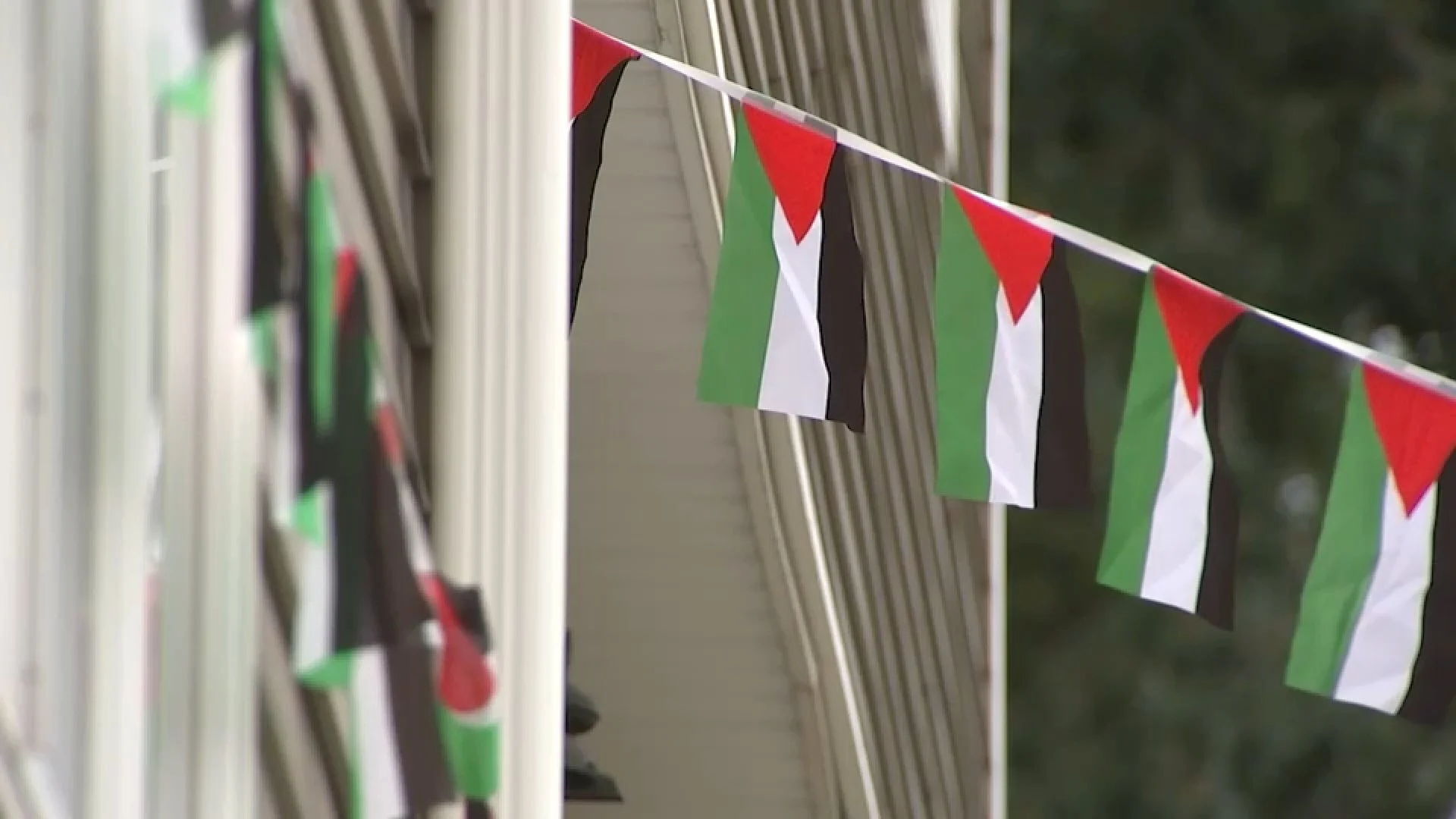
A Palestinian flag hangs outside a home in Yonkers. That should be an unremarkable fact.
Instead, for one Yonkers family, displaying that flag was followed by an anonymous letter addressed to them by name, demanding that they take the flags down and warning that their home was being watched.
According to reporting by ABC7 and a statement from the New York chapter of the Council on American-Islamic Relations, Samir Nofal and his family received the letter after displaying Palestinian flags outside their home. The letter told the family, "If you love Palestine so much, go back," demanded that they replace the Palestinian flags with American ones, and claimed their home was "under surveillance." The incident has been reported to the Yonkers Police Department, which is investigating.
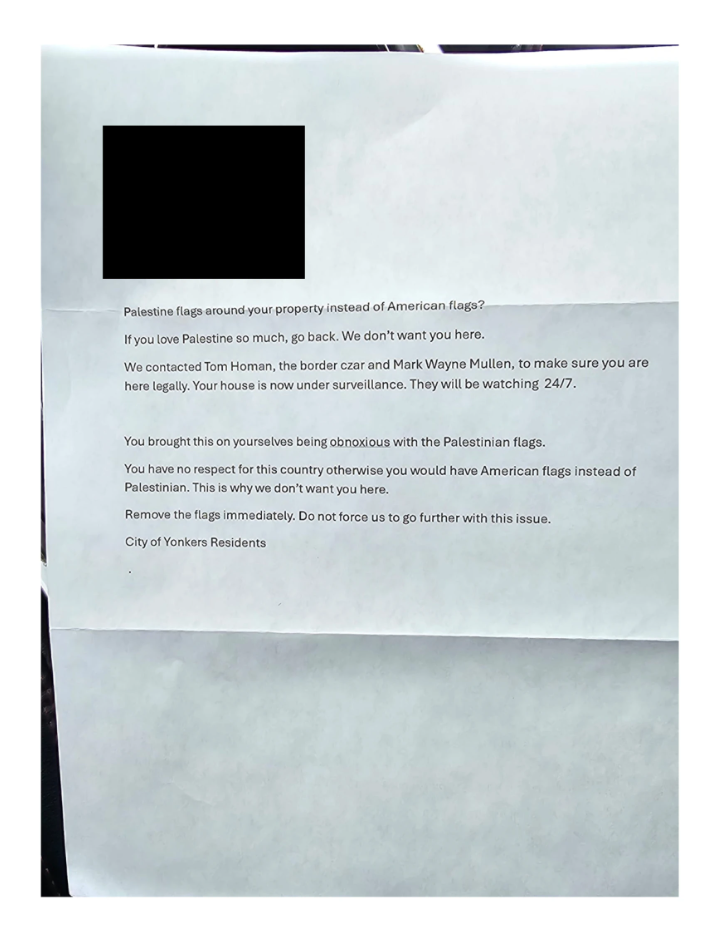
The threatening letter sent to Yonkers resident Samir Nofal’s family.
Photo courtesy of the Council on American-Islamic Relations (CAIR)
The letter has raised concerns about anti-Palestinian intimidation and what it means for residents who choose to make their identity or political views visible.
Nofal has made clear that he sees no contradiction between his Palestinian identity and his place in Yonkers.
"We should not have to fear being targeted simply because we chose to display a Palestinian flag outside our home," he said in a statement released by CAIR-NY. "I am a proud Yonkers resident, and displaying a Palestinian flag does not make me any less American or any less deserving of safety and respect."
The incident has significance beyond the Nofal family's home. Yonkers is a city shaped by communities with ties to countries and cultures around the world, where expressions of identity are part of the fabric of everyday life. For Palestinian residents, the letter raises a more immediate concern: whether publicly displaying that identity can make them a target.
The Yonkers incident also comes as efforts to restrict or penalize pro-Palestinian expression are receiving national attention.
Macklemore was removed from the remaining U.S. dates of Ed Sheeran's tour following his pro-Palestinian remarks onstage. Tour promoter Messina Touring Group said multiple stadiums had indicated they would not allow upcoming concerts to proceed with Macklemore on the bill. Sheeran later said the decision was not his and that he had attempted to mediate a resolution.
In professional sports, Houston Texans linebacker Azeez Al-Shaair was recently fined nearly $12,000 by the NFL for wearing eye black bearing the name of Hind Rajab, the five-year-old Palestinian girl killed in Gaza in 2024.
And at Yankee Stadium, a man carrying a Palestinian flag ran onto the field during the September 11 Yankees-Mets game before being tackled by security and arrested.
The controversy has brought renewed attention to a question that extends far beyond concert stages or sports venues: what effect do highly visible consequences and confrontations surrounding pro-Palestinian expression have on others deciding whether to speak publicly themselves?
In Yonkers, that question is no longer abstract.
The Nofal family's experience is now visible to every neighbor who has considered putting a Palestinian flag in a window, every resident deciding whether to attend a demonstration, and every person weighing how openly to speak about Gaza.
That is how intimidation can have a chilling effect beyond its immediate target. One person receives the letter, but many more receive the message.
No one has to agree with the Nofals, or with Macklemore, to recognize what is at stake when people begin calculating the personal or professional cost of expressing a political view. When the possibility of a threatening letter, surveillance, public backlash or lost opportunities becomes part of that calculation, the effect can extend far beyond the person directly targeted. It can shape who speaks, who stays silent and which views remain visible in public life.
